
3.2 Traditional Ronghua Production Process (Exemplified by the Northern School Technique)
Share
Q: If Ronghua has Southern and Northern schools, which one do we (the readers) belong to?
A: For most Ronghua enthusiasts, there is no need to focus on school distinctions; this is merely an introduction. As a pure folk art enthusiast, my skills integrate the essence of both Southern and Northern schools. The production process I follow is closer to the Northern school, while the aesthetic style leans towards the Southern school. Therefore, you need not dwell excessively on this issue; focusing on refining your skills is the correct path.
See the tutorial video: https://youtu.be/iUDu6lcs608
I had the privilege of visiting Master Cai Zhiwei, an outstanding inheritor of the Beijing Velvet Bird & Velvet Flower intangible cultural heritage technique. After a month of intensive study, I gained a preliminary understanding of the specialized terminology and production process of Northern school Ronghua. Next, let us explore the traditional Northern school Ronghua production process together.
Traditional Northern School Ronghua Production Process

01. Degumming Silk: Raw silk has a gelatinous coating on its surface. Degumming involves removing this coating by boiling the raw silk at high temperature, transforming it into degummed silk. The two most important factors in this step are water temperature and the degumming agent. The water temperature should be maintained between 90-100°C. During the boiling/waiting period for degumming, avoid rapidly increasing the heat. The degumming agent added before immersing the silk can be edible alkali or baking soda. The ratio of silk to edible alkali is 10:1, and the water volume should just cover the material.

02. Straightening Silk: Silk threads become curly after degumming. Straightening involves wringing out excess water and then vigorously stretching, pulling, and tugging the threads to straighten them.
03. Dyeing: Dyeing refers to soaking white degummed velvet to achieve the desired color for ideal crafting results. Traditional Northern school Ronghua commonly uses industrial textile dyes, which are alkaline.
04. Dividing Velvet: Dividing velvet means splitting a large bundle of velvet into smaller portions (requires two-person cooperation). Before use, the small portion is then cut in half. After securing it, the velvet fibers are slowly separated, and any small knots inside are cleaned out.

05. Securing the Velvet Row (拴拍子/拴条): This involves securing copper wires one by one onto the velvet row and fixing them in position. The requirement is even spacing between the wires, with clean and aesthetically pleasing ends, ensuring they do not cross or "fight."

06. Cutting the Velvet Row (剪拍子): After all the copper wires are secured on the entire row, it can be removed. Holding it on the palm, use large scissors to cut each wire evenly onto a board. This step is called "cutting the velvet row."
07. Aligning and Twisting Strips: After cutting, the velvet strips should be aligned and twisted promptly to prevent them from being knocked loose. Pinch the copper wire, align it with the central axis of the velvet strip, and then twist it again along the pre-twisted pattern of the wire—the entire strip will curl up. Twisting the strip involves densifying the aligned strip by twisting it tightly along the direction of the wire's grain (usually twisting forward) on a twisting board.

08. Cupping/Gathering the Strip (捧条): This technique, derived from the aligning step, saves velvet strips that have shed fibers. By squeezing both ends of the copper wire, the middle part slightly opens. The shed fibers are gathered back into this gap to avoid unnecessary waste. This operation highly tests the maker's proficiency.

09. Trimming/Shaping (刹活儿): This refers to using scissors and a trimming pot/jar to trim velvet strips into different shapes. It is the most technically demanding step in the entire process. The trimming pot/jar is a unique and very important auxiliary tool in Northern school Ronghua, enabling fast and aesthetically pleasing trimming of velvet strips.

10. Assembling/Piecing Together (攒活儿): This involves assembling the velvet strips according to the designed outline. This step tests the maker's aesthetic sense and overall coordination ability.
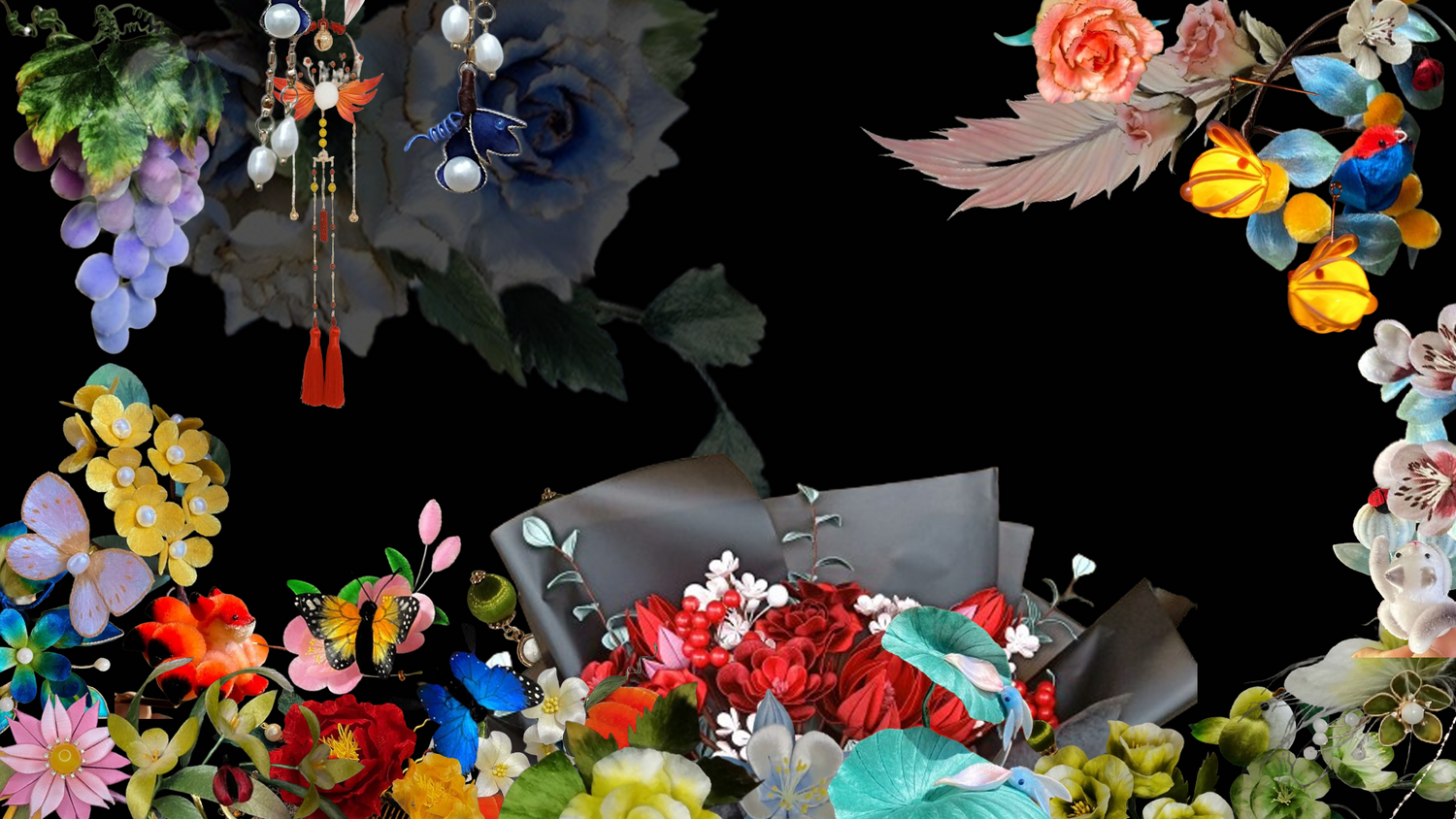
11. Completion: The image shows a traditional Northern school floral form—the "Treasure Basin."
Tips:
① Southern and Northern schools have different names for production steps. For example, the Northern school's "刹活儿 (shā huór)" is called "打尖 (dǎ jiān)" in the Southern school process. The Northern school's "攒活儿 (cuán huór)" is called "传花 (chuán huā)" in the Southern school. Many enthusiasts mix terminologies during self-study, which is not inherently wrong; it's simply different naming conventions between the schools.
② Master Cai's workshop uses specially made copper wire, not the common type, which is less prone to oxidation.