
3.5 & 3.6 A Practical Guide to Quantities and Formulas
Share
How to Measure and Arrange Different Types of Thread
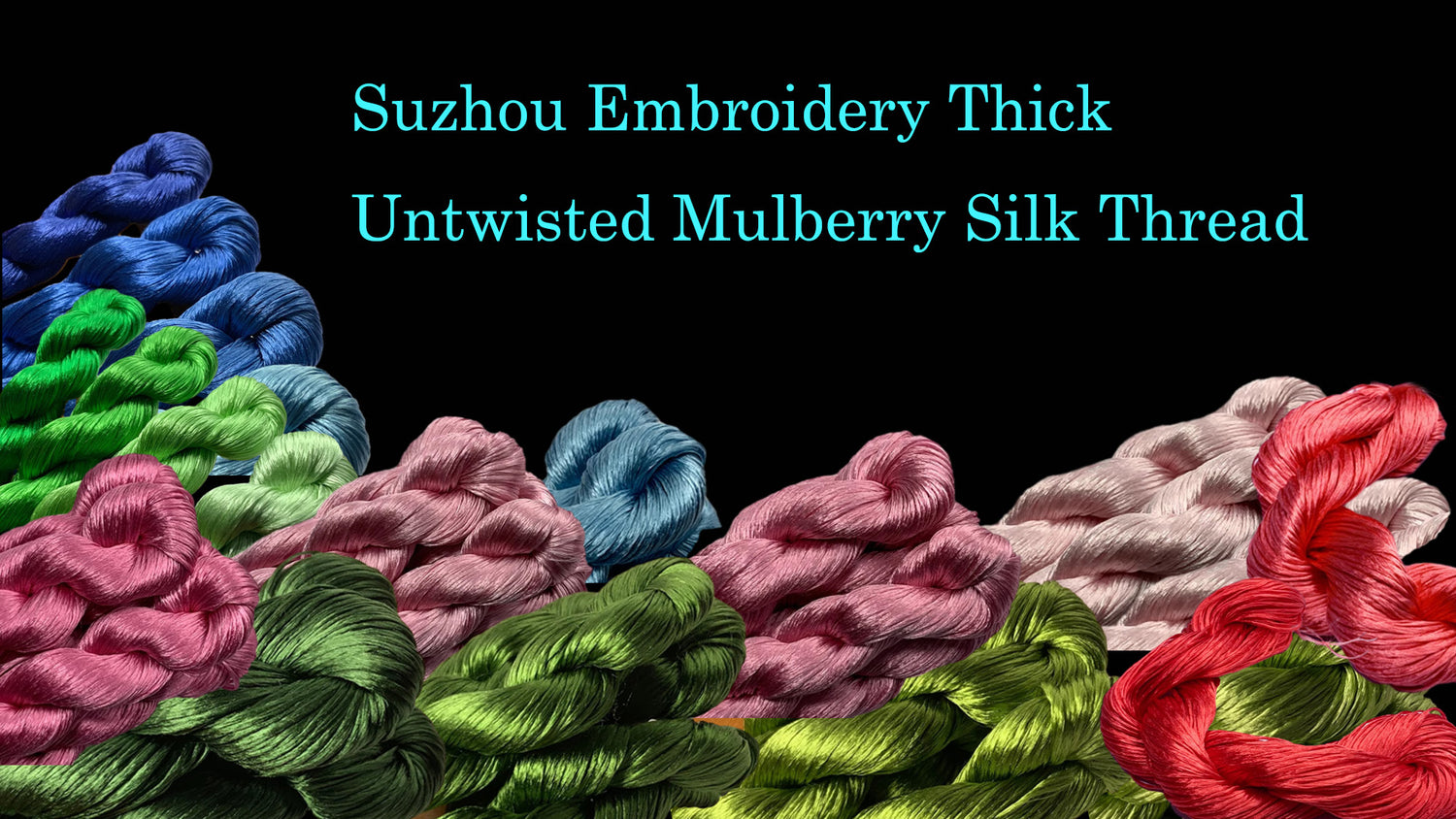
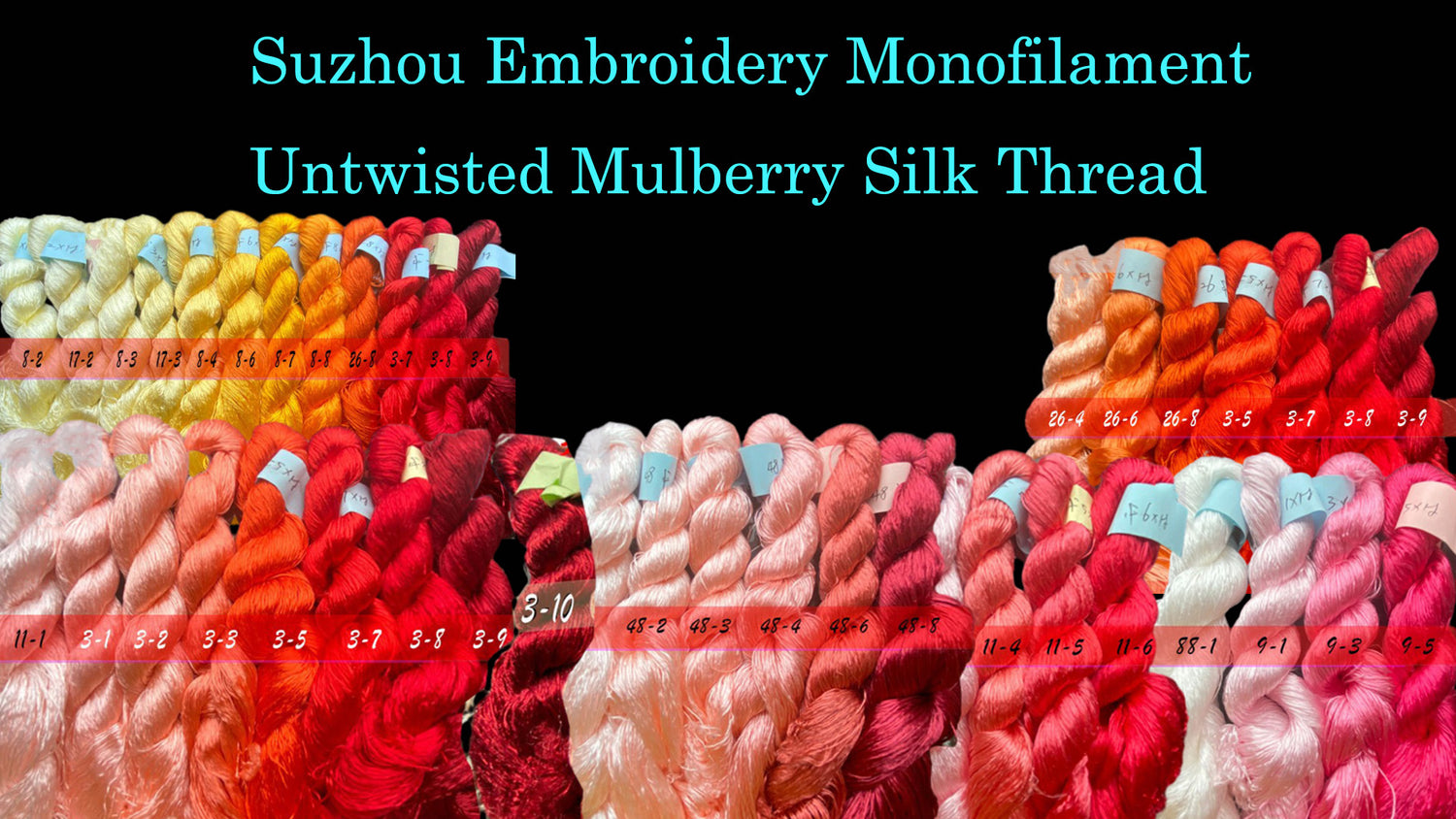
Given the variety of thread materials currently available on the market, we have calculated a standard equivalent conversion for your reference: The amount for one bundle of thread (112 strands) ≈ 7 strands of Suzhou Embroidery Untwisted Mulberry Silk Thread ≈ 1 to 1.5 strands of Hunan Embroidery Mulberry Silk Thread (Hunan embroidery thread is a special case, varying in thickness; the amount can be adjusted based on the actual thread used).
Calculation Principle: Using the thread amount of Suzhou Embroidery Untwisted Mulberry Silk Thread as the benchmark, a single strand contains 16 strands of silk (filaments). If one bundle consists of 7 strands, then the total amount for that bundle is 16 × 7 = 112 filaments. For beginners, the key is to identify the type of thread purchased and the number of filaments per strand, and then perform the equivalent conversion. For example, if you purchase thick twisted thread, with each strand containing 60 filaments, then one bundle should consist of 2 strands of thick twisted thread (i.e., 60 × 2 = 120 filaments). Given the diversity of silk thread types, an error margin of 40-50 filaments is acceptable during conversion.
Note: The amount for one bundle of thread is not fixed but is flexibly determined based on the maker's personal habits and needs. This amount setting is directly linked to the calculation formula for velvet strip usage in the next section and serves as the foundation for the material amounts in all subsequent flower styles. If you already have your own understanding and calculation method for material amounts, you need not strictly adhere to the suggestions in this article, nor should you overly concern yourself with their absolute correctness.
Formula for Velvet Strip Usage
Q: Is the velvet strip usage formula the sole criterion for determining the amount?
A: No, the formula is merely a convenient tool for beginners to make deductions. If you are proficient in making velvet flowers (Ronghua), then referencing this formula becomes unnecessary. The formula presented here is based on the author's years of teaching experience. Each person's usage habits differ; it is not an absolute or algorithm.
Basic Formula
3n (Here, 3 refers to the velvet amount for three bundles, and n refers to the width of the velvet row. It's important to note that n must be an integer, e.g., 2, 3, 4, 5, etc.). This formula applies to both fluffy velvet styles and flattened clamp styles. To achieve other effects, please refer to the formula variations below.
Example: When the velvet row width is 5cm, the required amount can be calculated using the formula 3 × 5 = 15 bundles.
For special velvet row widths, the rounding method can be applied.
Examples:
① If the velvet row width is 4.3cm, the amount can be calculated based on a width of 4cm, i.e., 3 × 4 = 12 bundles.
② If the velvet row width is 4.8cm, the amount can be calculated based on a width of 5cm, i.e., 3 × 5 = 15 bundles.
③ For borderline cases, e.g., a velvet row width of 4.5cm, you can calculate the amount based on a 4cm width and then add 1 bundle, i.e., 3 × 4 + 1 = 13 bundles.
Formula Variations
① Folded Fluffy Velvet Style: 3n + (2~4) bundles (Applicable to common basic folded styles like jasmine, plum blossoms, etc.).
② Flattened Clamp Style: 3n - (2~4) bundles (Applicable to all flattened clamp style flowers).
③ Thin Velvet Strips + Long Velvet Strips (Long strips with a thickness of 3mm and below):
Northern School Usage: 3n (Please note, the effect of this 3n is completely different from the previous one. This specifically emphasizes making thin velvet strips. Because the thickness of the velvet strips differs, even with the same silk thread amount, the visual effect of the finished strips will vary).
Southern School Usage: 3n - (2~3) bundles (Results in a more translucent effect, which is recommended).
Some Additional Tips
Q: When making flattened clamp styles, after reducing the amount according to the formula, there are large gaps between thread bundles. What should I do?
A: Under the premise of proper total amount control, we can adjust the original grouping of 7 strands per bundle to 4 strands per bundle. This way, the number of bundles increases accordingly, naturally reducing gaps. Changing the grouping strategy while keeping the total thread amount constant is also a viable option. Alternatively, we can choose not to make special adjustments, as the silk thread will gradually expand during the combing process, naturally filling any potential gaps. In short, just follow the established process and ensure the silk thread is fully combed.
Q: When making 2mm thin velvet strips, following the formula results in the brass wire being quite visible. What should I do?
A: If the brass wire is visible in thin velvet strips, please check the following reasons:
① Whether the velvet has not been fully combed open. Both folded fluffy velvet styles and thin velvet strips have very high requirements for combing velvet, so do not skimp on this step.
② Whether you chose to straighten the silk thread using a clamp/flat iron at its highest temperature. Excessively high temperature can cause the silk threads to stick together. If this is the cause, you can use tweezers or a steel comb to gently scrape the velvet strip, manually opening up the velvet.
③ Possibly due to overly stringent self-expectations. It's important to recognize that the brass/copper wire is an essential skeletal structure of the velvet strip. Regardless of attempts to increase or decrease its amount, subtle traces of the wire are difficult to completely conceal. As long as it is within an acceptable range, there is no need to overthink it. Beginners during practice should avoid falling into the trap of pursuing absolute perfection to prevent unnecessary frustration.